
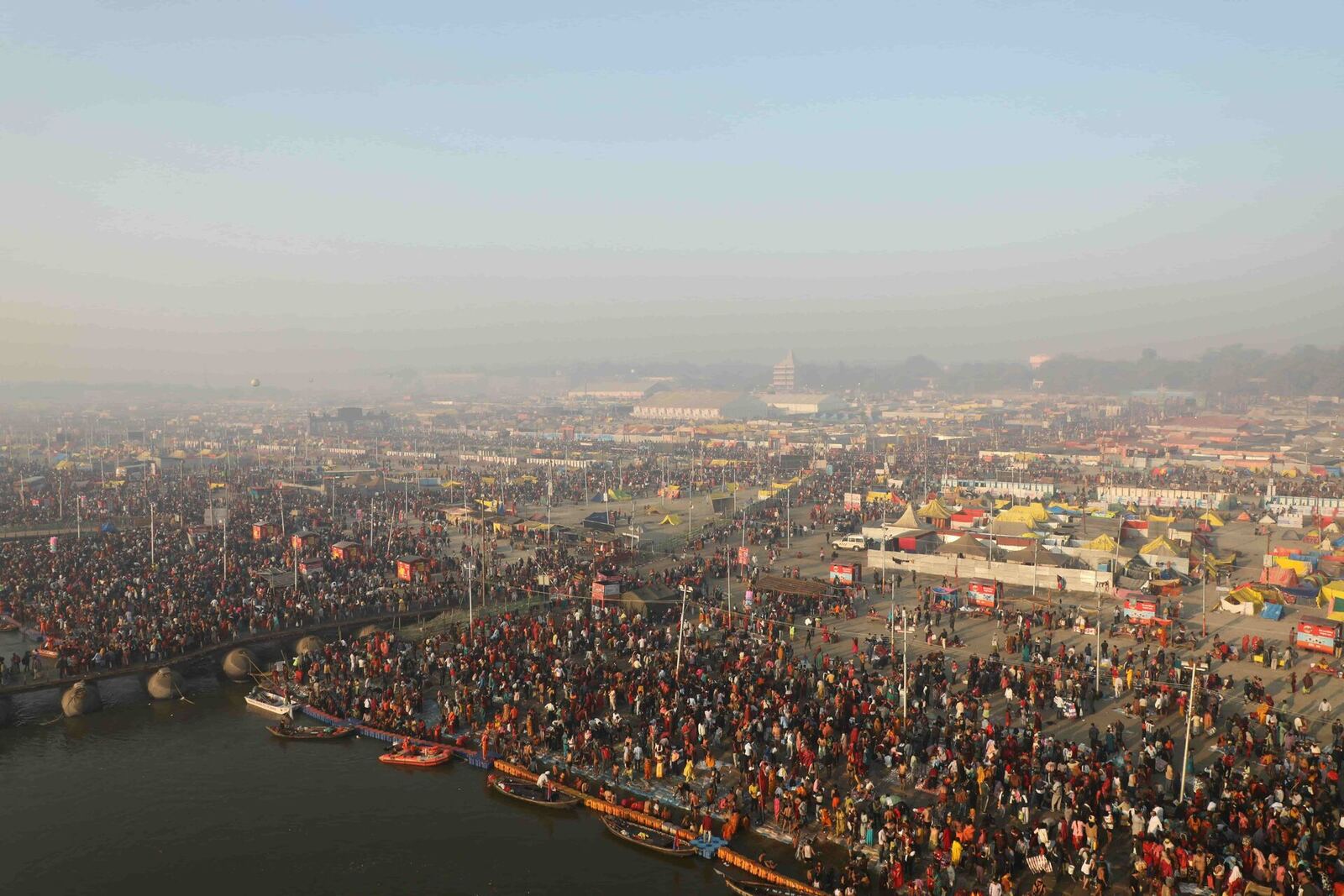
Once every twelve years, when Jupiter enters Leo (Simha Rashi), the Godavari at Nashik and Trimbakeshwar transforms into one of the largest spiritual gatherings on Earth. The Nashik–Trimbakeshwar Simhastha Kumbh Mela 2026–2028 begins with the Dhwajarohan flag-hoisting on 31 October 2026, peaks across three royal baths (Amrit Snan) in August–September 2027, and concludes on 24 July 2028. This guide gives you everything you need — exact dates, sacred sites, akhada parades, travel logistics and how to plan a trip that is both meaningful and comfortable.
What is the Kumbh Mela?
The Kumbh Mela is the world’s largest religious congregation. Its origin is rooted in the Hindu story of the Samudra Manthan — the cosmic churning of the ocean of milk by the devas (gods) and asuras (demons) in pursuit of amrit, the nectar of immortality. As the divine bird Garuda carried the kumbh (pot) of nectar to the heavens, four drops fell on Earth — at Prayagraj, Haridwar, Ujjain and Nashik. The Kumbh Mela rotates between these four cities every three years, so each city hosts a Purna Kumbh roughly every twelve years.
Astronomically, the dates are decided by the relative positions of the Sun, Moon and Jupiter (Brihaspati). The Nashik–Trimbakeshwar Kumbh is called the Simhastha because it falls when Jupiter sits in the zodiac sign of Simha (Leo). It is one of only two Kumbhs at this celestial alignment — the other being Ujjain.
Why Nashik–Trimbakeshwar? The Simhastha connection
Nashik sits on the banks of the Godavari, considered the “Ganga of the South.” The river rises at Brahmagiri Hill in Trimbakeshwar, roughly 30 km from Nashik city, where it first emerges as Kushavarta Kund. Both points are sacred — and during the Simhastha they are activated together: Vaishnava akhadas bathe at Ramkund in Nashik’s Panchavati area, while Shaiva akhadas bathe at Kushavarta in Trimbakeshwar.
The cultural weight of Nashik runs even deeper. Panchavati is where Lord Rama, Sita and Lakshmana spent part of their forest exile in the Ramayana. The Trimbakeshwar Temple, meanwhile, houses one of the 12 Jyotirlingas of Lord Shiva — making this Kumbh equally significant for both Vaishnava and Shaiva traditions.
Kumbh Mela 2026 dates: official schedule
The festival spans almost 21 months — among the longest Kumbh Melas on record. Below are the dates announced by the Government of Maharashtra and the Nashik–Trimbakeshwar Mela Pradhikaran.
| Date | Occasion | Notes |
|---|---|---|
| 31 October 2026 | Dhwajarohan (Flag Hoisting) | Official start of the Simhastha at Trimbakeshwar — invocation by the akhadas. |
| 2 August 2027 | 1st Amrit Snan / Shahi Snan | Ashadh Somvati Amavasya — first royal bath; Naga Sadhus lead the procession. |
| 31 August 2027 | 2nd Amrit Snan / Shahi Snan | Shravan Amavasya — second royal bath at Ramkund (Nashik) and Kushavarta (Trimbakeshwar). |
| 11 September 2027 (Nashik) | 3rd Amrit Snan — Nashik | Bhadrapada Shuddha Ekadashi — final royal bath at Ramkund, Panchavati. |
| 12 September 2027 (Trimbakeshwar) | 3rd Amrit Snan — Trimbakeshwar | Vaman Dwadashi — final Shaiva akhada bath at Kushavarta Kund. |
| 24 July 2028 | Festival Conclusion | Official close of the Nashik–Trimbakeshwar Simhastha Kumbh Mela. |
In addition to the three Amrit Snan days, the festival includes 40+ minor bathing days tied to ekadashis, purnimas, amavasyas and other auspicious tithis across 2026 and 2027. If you are visiting purely for darshan and want to avoid the biggest crowds, these in-between days offer a calmer experience while still being spiritually significant.
Types of Kumbh Mela (and why 2026 Prayagraj is not a Kumbh)
Search results often confuse different fairs that share the “mela” suffix. Here is the clean taxonomy:
- Maha Kumbh: Held only at Prayagraj, once every 144 years (after twelve Purna Kumbhs). The most recent was January–February 2025.
- Purna Kumbh: The standard 12-year Kumbh at each of the four cities. The Nashik–Trimbakeshwar Simhastha 2026–2028 is a Purna Kumbh.
- Ardh Kumbh: Held every 6 years, only at Prayagraj and Haridwar — a “half” Kumbh between the Purna cycles.
- Magh Mela: An annual fair at Prayagraj during the Hindu month of Magh (Jan–Feb). The 2026 Prayagraj Magh Mela is not a Kumbh — it is the regular yearly gathering.
- Simhastha: A Purna Kumbh that occurs when Jupiter is in Leo — specifically Nashik–Trimbakeshwar and Ujjain.
So the question “Is there a Kumbh in 2026?” has a clear answer: yes — the Simhastha at Nashik and Trimbakeshwar.
Nashik vs Trimbakeshwar: what each city offers
Nashik
The bigger of the two hosts, Nashik anchors the Vaishnava side of the Kumbh. The Ramkund at Panchavati is the central bathing ghat — believed to be where Lord Rama performed last rites for King Dasharatha. Beyond the bathing days, don’t miss:
- Kalaram Mandir — a 200-year-old black stone temple to Rama, just walking distance from Ramkund.
- Sundarnarayan Temple — riverside Vishnu temple with elegant Maratha-era architecture.
- Sita Gufa — the small cave shrine in Panchavati associated with Sita’s abduction.
- Coin Museum & Pandavleni Caves — for visitors with an extra day, a sharp contrast to the spiritual pace.
Trimbakeshwar
30 km from Nashik (1–1.5 hours by road), Trimbakeshwar is the spiritual headquarters of the Shaiva akhadas. The Kushavarta Kund is the bathing pool where the Godavari is said to first surface; the Trimbakeshwar Jyotirlinga Temple next door is one of the 12 jyotirlingas. Around it:
- Brahmagiri Hill — the actual source of the Godavari; a 750-step climb leads to Gangadwar.
- Anjaneri Hill — believed to be the birthplace of Lord Hanuman.
- Niwali Sangam — confluence of three rivers, popular for tarpan rituals.
On Shahi Snan days, traffic between Nashik and Trimbakeshwar is severely restricted. Choose one of the two for darshan that day, and visit the other on a quieter day.
Akhadas, Naga sadhus & sacred bathing rituals
Thirteen recognised akhadas (monastic orders) participate in the Simhastha. Each akhada has its own Mahamandaleshwar, its own dharmik banner and a strict precedence at the ghats. Broadly:
- Vaishnava akhadas (worshippers of Vishnu/Rama) lead the procession at Ramkund, Nashik.
- Shaiva akhadas (worshippers of Shiva), including the famous Naga Sadhus, lead the bathing at Kushavarta, Trimbakeshwar.
- Udasin akhadas (followers of Guru Nanak’s son Sri Chand) bathe after the principal orders.
Sadhugram — a vast, purpose-built tent city — is set up to host the akhadas, their Mahamandaleshwars and their followers. On Shahi Snan days, akhadas process from Sadhugram to the ghats in a fixed order, accompanied by horses, elephants, chariots and ceremonial weapons. As a visitor, the procession is a once-in-a-lifetime sight — but you must not step into the bathing area until the akhadas finish their ritual.
How to reach Nashik & Trimbakeshwar
By air
Nashik (Ozar) Airport (ISK) is 25 km from the city and has limited flights. Most travellers arrive via Mumbai (BOM, ~170 km) or Pune (PNQ, ~210 km), both well-connected internationally. Pre-paid taxis and Volvo coaches run from Mumbai/Pune to Nashik in 4–5 hours. Expect surge pricing in the days surrounding each Shahi Snan.
By rail
Nashik Road railway station (NK) sits on the busy Mumbai–Bhusaval line; over 100 trains stop here daily. Indian Railways operates additional Kumbh specials from Mumbai, Pune, Nagpur, Indore, Bhopal, Delhi and Hyderabad on Shahi Snan weeks. Book at least 60–90 days ahead for premium classes.
By road
Approximate driving times to Nashik:
- Mumbai → Nashik via NH-160: ~4 hours (170 km)
- Pune → Nashik via NH-60: ~5 hours (210 km)
- Indore → Nashik via NH-52: ~9 hours (450 km)
- Ahmedabad → Nashik: ~10 hours (550 km)
- Hyderabad → Nashik: ~13 hours (700 km)
On Shahi Snan days, vehicles are stopped at outer parking zones (P1–P6 around Nashik) and only shuttle buses ply into the inner zone. Plan to arrive a day early.
Where to stay during the Kumbh Mela
Accommodation during the Simhastha falls into five tiers — and pricing on Shahi Snan weeks is 3–5× higher than off-peak. Book 3–6 months in advance.
- Sadhugram tent city: The official tented township for sadhus and registered pilgrims. Limited public availability.
- Premium hotels & resorts in Nashik: The Gateway, Express Inn, Ginger, Ibis and several boutique vineyard stays in the wine country (Sula, York). ₹6,000– ₹20,000/night during peak days.
- Mid-range hotels and dharamshalas: Ahilyadevi Holkar Dharamshala, Tapovan Dharamshala, Trimbakeshwar Devasthan guesthouses. ₹1,200–₹4,000/night.
- Tented camps near the ghats: Set up by tour operators for the festival period. ₹2,000–₹10,000/night depending on tier.
- Mumbai or Pune as base: A practical option for visitors who want modern hotels and don’t mind a 4–5 hour day-trip on a non-Shahi day.
Best time to visit (and what to expect on each Snan)
If your goal is the spectacle of the akhada parade, target one of the three Amrit Snan days in 2027. If you want quieter darshan, the minor bathing days (ekadashis, purnimas, amavasyas) between November 2026 and June 2028 are far more relaxed.
- 2 August 2027 (1st Amrit Snan): Monsoon season — pack a light rain shell. Crowd estimate: 80 lakh–1 crore (8–10 million).
- 31 August 2027 (2nd Amrit Snan): Late monsoon. Expect heavy rain risk. Crowd peaks around 1.2–1.5 crore (12–15 million).
- 11–12 September 2027 (3rd Amrit Snan): Crowds peak — historically the largest day of the cycle, sometimes 1.5–2 crore (15–20 million).
For first-time visitors who want the experience without the heaviest crush, we recommend arriving 2–3 days before a Shahi Snan, witnessing the akhada procession from a designated viewing point, then bathing on the day after when ghats are quieter.
Travel tips & packing list
- Documents: Carry photo ID (Aadhaar / passport), 2–3 photocopies, and digital copies on your phone. International visitors should carry their passport.
- Footwear: Sturdy, easy-to-remove sandals. You will walk 8–15 km on Shahi Snan day with multiple temple stops requiring shoes-off.
- Clothing: Modest, quick-dry. Cotton kurta-pyjama or salwar suit is ideal. Carry a change for after the dip.
- Health kit: Personal medication, ORS sachets, paracetamol, small first-aid pouch, hand sanitiser, wet wipes.
- Power & cash: Power bank (network often saturates), small denomination cash for prasad, donations and street food.
- Monsoon prep: Lightweight rain poncho, dry-bag for phone & wallet — the August Snans fall mid-monsoon.
- Group safety: Fix a meeting point in advance. Mobile networks slow down dramatically in dense crowds.
Safety, health & official apps
The Maharashtra government deploys 50,000+ police personnel, NDRF teams, drone surveillance and AI-enabled CCTV across both Nashik and Trimbakeshwar during Shahi Snan days. Medical camps and ambulances are stationed every 500 metres at the ghats.
- Nashik Kumbh Mela official app (released by the Mela Pradhikaran): live ghat status, parking zones, lost-and-found, helpline.
- Police helpline: 112 (universal); Nashik Kumbh control room numbers are published closer to each Shahi Snan.
- Live darshan: Doordarshan and the official portal stream Shahi Snans and major aartis live for those who cannot travel.
Stampede safety: Move with the crowd, never against. If you feel pressed, raise your arms to your chest, shout to people behind you to step back, and look for a wall or post to anchor against.
Plan your Kumbh Mela trip with Traverse
Traverse has been organising pilgrimage and cultural trips out of Indore since 2014. For the 2026–2028 Simhastha we curate three trip styles:
- Shahi Snan Special (3–4 nights): Pre-snan arrival, akhada procession viewing, escorted ghat darshan, return.
- Spiritual Maharashtra (6–7 nights): Kumbh + Trimbakeshwar Jyotirlinga + Shirdi + Shani Shingnapur.
- Quiet Darshan (2–3 nights, off-peak): Minor bathing days for travellers who want depth without the crush — ideal for older pilgrims.
All trips include vetted accommodation booked months in advance, AC transfers, English and Hindi-speaking guides, and 24/7 ground support. We are based in Indore and run departures from Indore, Mumbai, Pune, Delhi and Bengaluru.
Kumbh Mela 2026: frequently asked questions
When does the 2026 Kumbh Mela start?
The Nashik–Trimbakeshwar Simhastha Kumbh Mela officially begins with the Dhwajarohan (flag-hoisting) ceremony on 31 October 2026 and runs until 24 July 2028. The main royal bathing days fall in 2027.
What are the Shahi Snan / Amrit Snan dates for the 2026 Kumbh Mela?
There are three Amrit Snan dates: 2 August 2027 (Ashadh Somvati Amavasya), 31 August 2027 (Shravan Amavasya) and 11–12 September 2027 (Bhadrapada Ekadashi at Ramkund, Vaman Dwadashi at Kushavarta).
Where is the 2026 Kumbh Mela held?
It is held simultaneously in two locations in Maharashtra: Nashik (along the Godavari at Ramkund, Panchavati) and Trimbakeshwar, about 30 km away, at Kushavarta Kund — the symbolic source of the Godavari and home to one of the 12 Jyotirlingas.
Is there a Kumbh Mela in Prayagraj in 2026?
No. Prayagraj hosts the annual Magh Mela in January–February 2026, which is a smaller, separate event. The next full Maha Kumbh at Prayagraj will follow its own 12-year cycle. The 2026–2028 Kumbh is the Nashik–Trimbakeshwar Simhastha.
How long does the Nashik Kumbh Mela last?
Roughly 21 months — one of the longest Kumbh Melas held. From the 31 October 2026 flag-hoisting to the 24 July 2028 conclusion. Most pilgrims time their visit around the three Amrit Snan days in August–September 2027.
How many people attend the Kumbh Mela?
Tens of millions across the festival period. Past Nashik Simhasthas have drawn 70–90 million attendees over the cycle, with single Shahi Snan days alone seeing 1–2 crore (10–20 million) people at the ghats.
Can the Kumbh Mela be watched live online?
Yes. The Maharashtra government and partner platforms broadcast the Shahi Snans and major aartis live. Doordarshan, the official Nashik Kumbh Mela portal and several news channels provide live streams during peak days.
Do I need any special permission or pass to attend?
No special permission is needed for the public bathing days — entry is free. However, on Shahi Snan days police impose route restrictions and one-way crowd flow. We recommend arriving the day before, carrying photo ID, and pre-booking accommodation.